Our story

From convent to brewery

A convent stood on this ground around 1450, and its sisters fattened cattle for the banquets of the civic guard. Copper kettles have brewed on this spot since 1992, and as De Bekeerde Suster since 2004.

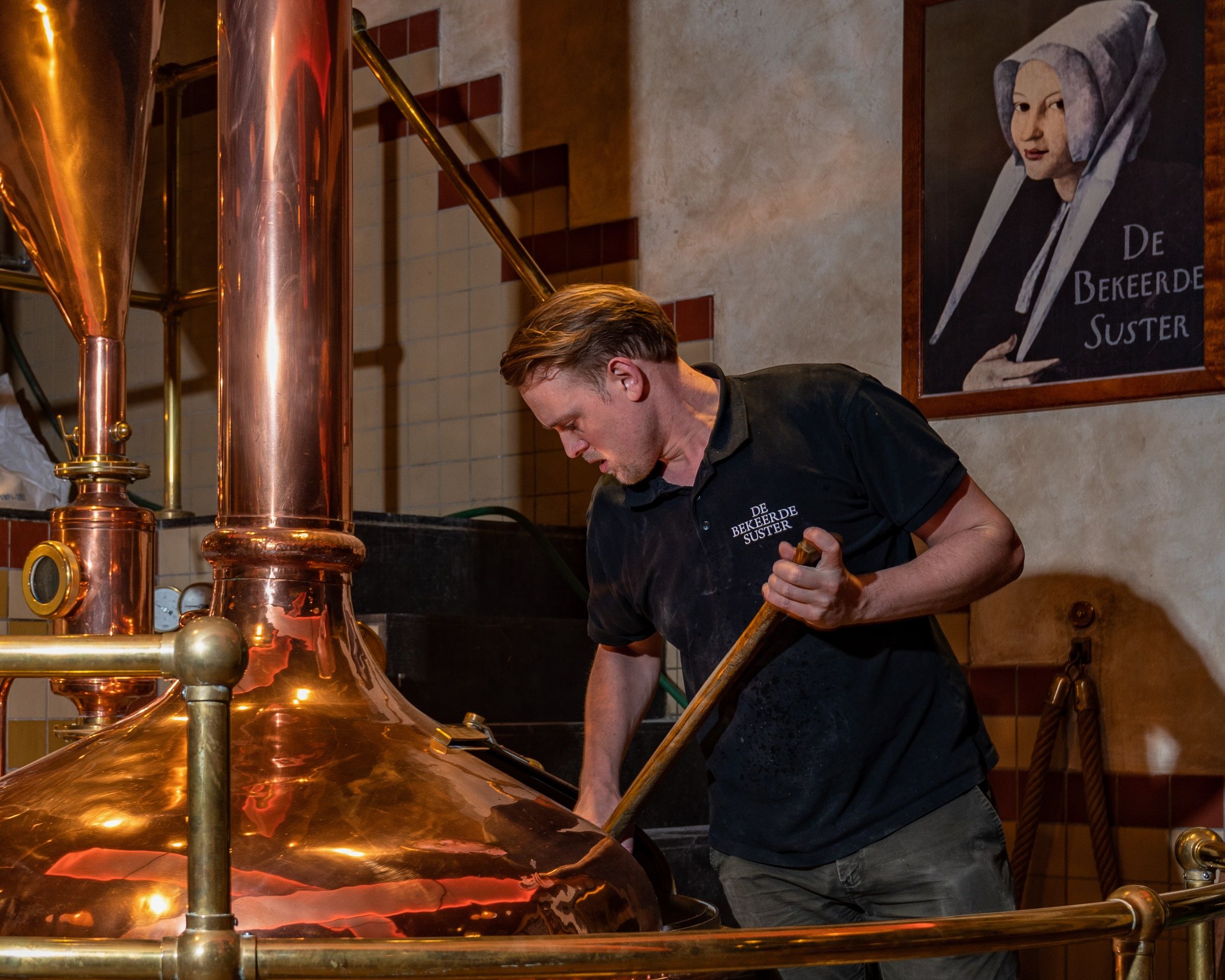
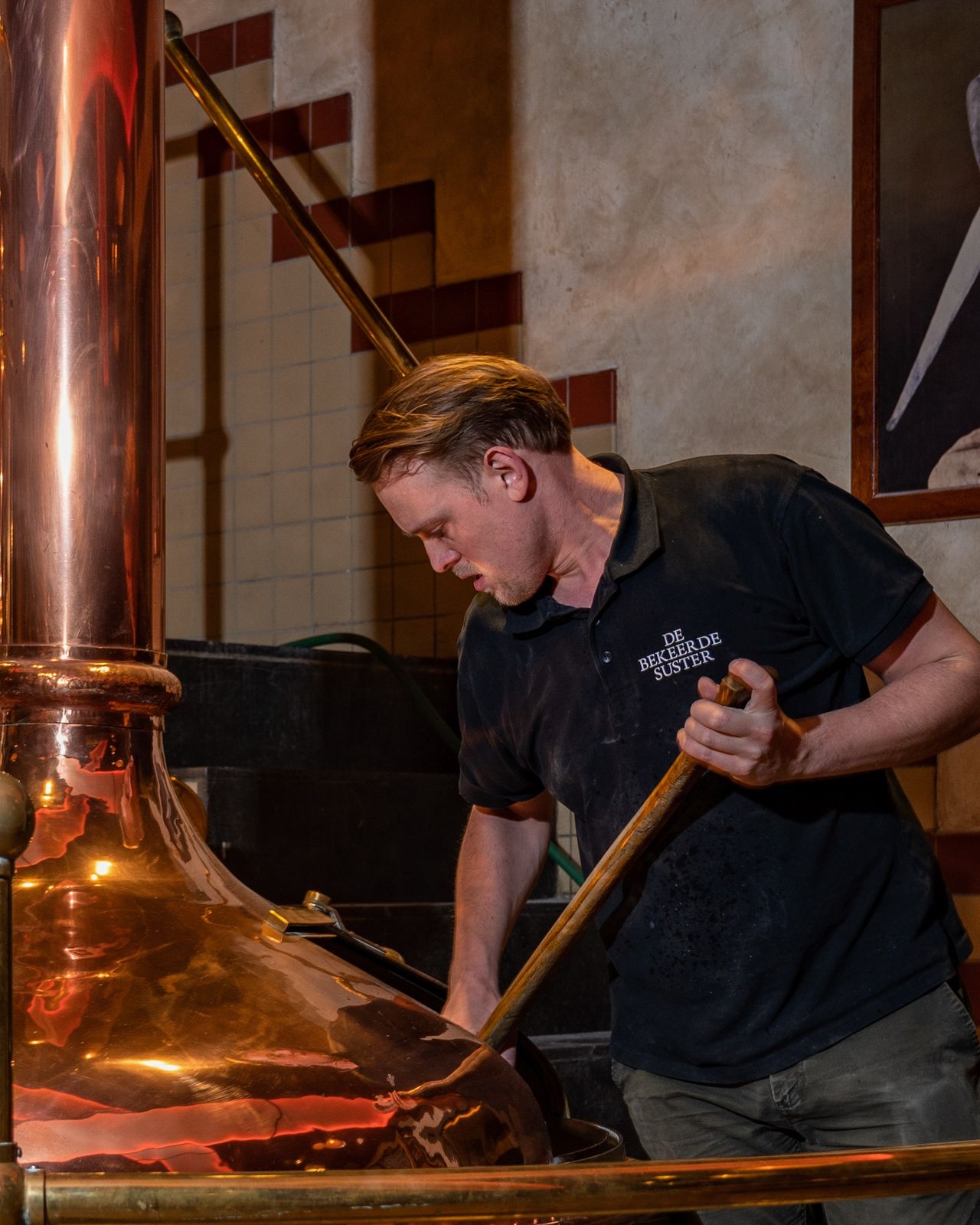
A brewer stirs the mash in the open copper kettle with a long paddle, below the portrait of the converted sister.

Year: c. 1450

The Bethaniën convent

Around 1450 a convent rose on this ground: Sinte Maria Magdalena van Bethaniën, the Bethaniënklooster. The story goes that Arent Moey and Weyn Pieter Ghijbertsdochter founded it as a refuge for women who wanted to leave their old lives behind. They were called the bekeerde susteren, the converted sisters, and that is where our name comes from.

The sisters lived by the rule of Augustine. At its largest the convent filled the block between the Kloveniersburgwal, the Oudezijds Achterburgwal, the Barndesteeg and the Bethaniënstraat. Our bar stands on part of that ground.
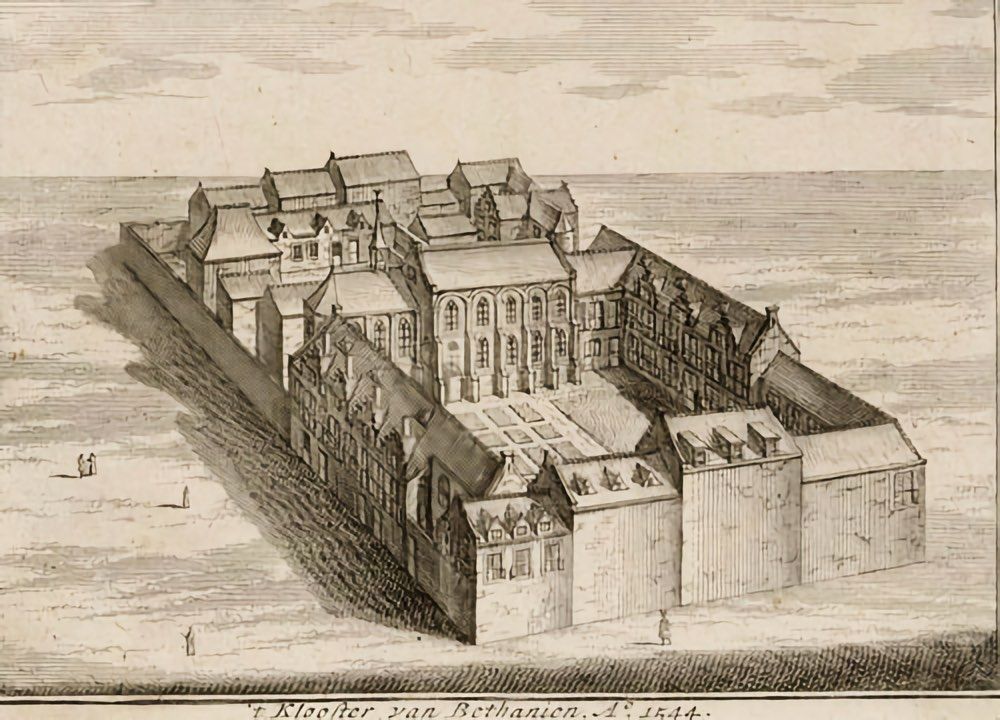
Drawing of the Bethaniën convent that once stood on this spot
The Bethaniën convent in a bird's-eye drawing. It stood between the Kloveniersburgwal and the Oudezijds Achterburgwal.

Year: 1462

First on record

The first firm date is 1462. That year the sisters were allowed to build their own chapel, with a churchyard and a chaplain of their own. Later sources say around 220 women lived here by then: nuns, and women who had bought board and lodging for life.

The convent is on the first printed map of Amsterdam, drawn by Cornelis Anthonisz in 1544, just inside the city wall.

Year: 16th c.

Cattle for the civic guard

The sisters earned their keep. They fattened cattle on the convent grounds, and the beef went to the banquets of the Amsterdam civic guard, the schuttersmaaltijden. In 1525 the city cut a street through the grounds to the convent church. It is still called the Koestraat: Cow Street.

Whether they also brewed: like most convents, according to tradition. Beer was the everyday drink and every large house made its own. No document says so for the sisters, so we tell it as a story, not as a fact.

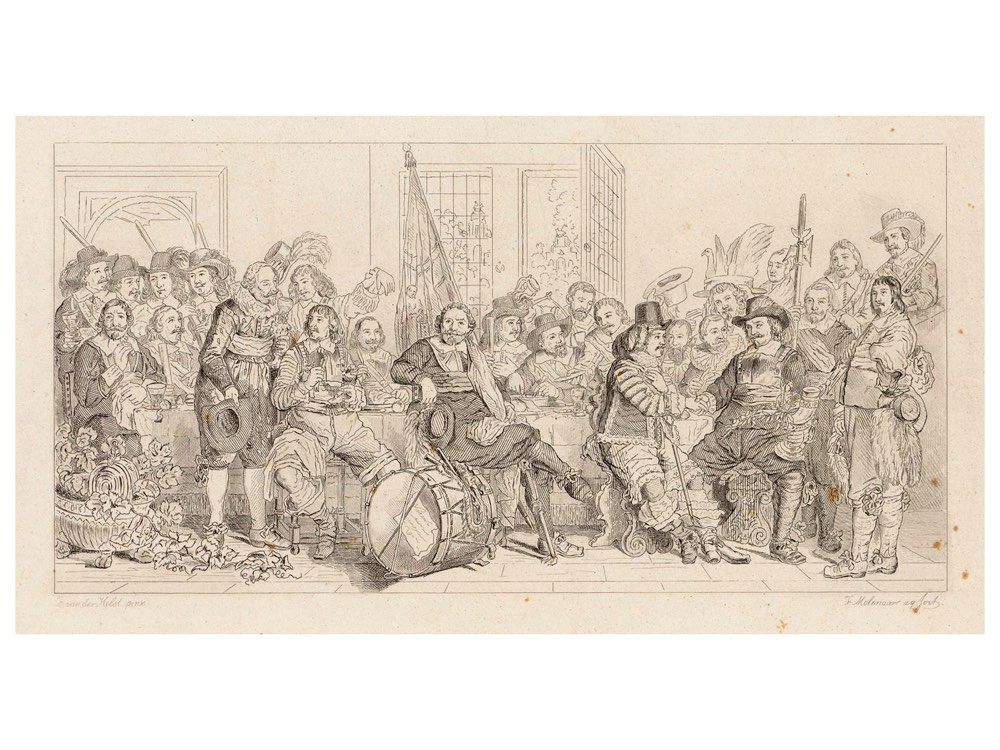
Banquet of the Amsterdam civic guard celebrating the Peace of Münster, painting by Bartholomeus van der Helst, 1648
Bartholomeus van der Helst, banquet of the Amsterdam civic guard, 18 June 1648. Rijksmuseum, public domain. The kind of feast the sisters' cattle once fed; by 1648 the convent was long gone.

Year: 1578–1585

The Alteratie

In 1578 Amsterdam went over to the Protestant side, the Alteratie, and the city took the convent and its land. In 1585 the order was dissolved. The nine sisters who remained were housed elsewhere in the city, and the land was parcelled out for houses. In 1594 the nave of the convent church became the Latin school of the Oude Zijde.

Part of the convent still stands. Walk into the Barndesteeg and the long plastered wall halfway down the alley is its north wing, with a two-aisled Gothic cellar from the third quarter of the fifteenth century beneath it. Parts of the wing are listed as national monuments (rijksmonumenten 331 and 332).

Year: 1722

Three houses, three patriarchs

After the convent came houses. By 1680 two stood here, De Stadt Essen and De Gestofferde Luyermand. In 1722 both were pulled down and three tall houses took their place, named after the patriarchs: Jacob at number 4, Abraham at number 6 and Isaac at number 8. Look up from the terrace: the carved heads on the neck gables are by Anthonie Turck, one of the leading Amsterdam sculptors of the early eighteenth century.

De Bekeerde Suster lives in the ground floors and cellars of Abraham and Isaac, numbers 6 and 8. Both houses have belonged to Stadsherstel Amsterdam, the city's heritage foundation, since 1965; they were restored in 1980, and there has been a café on this ground floor since the 1960s.

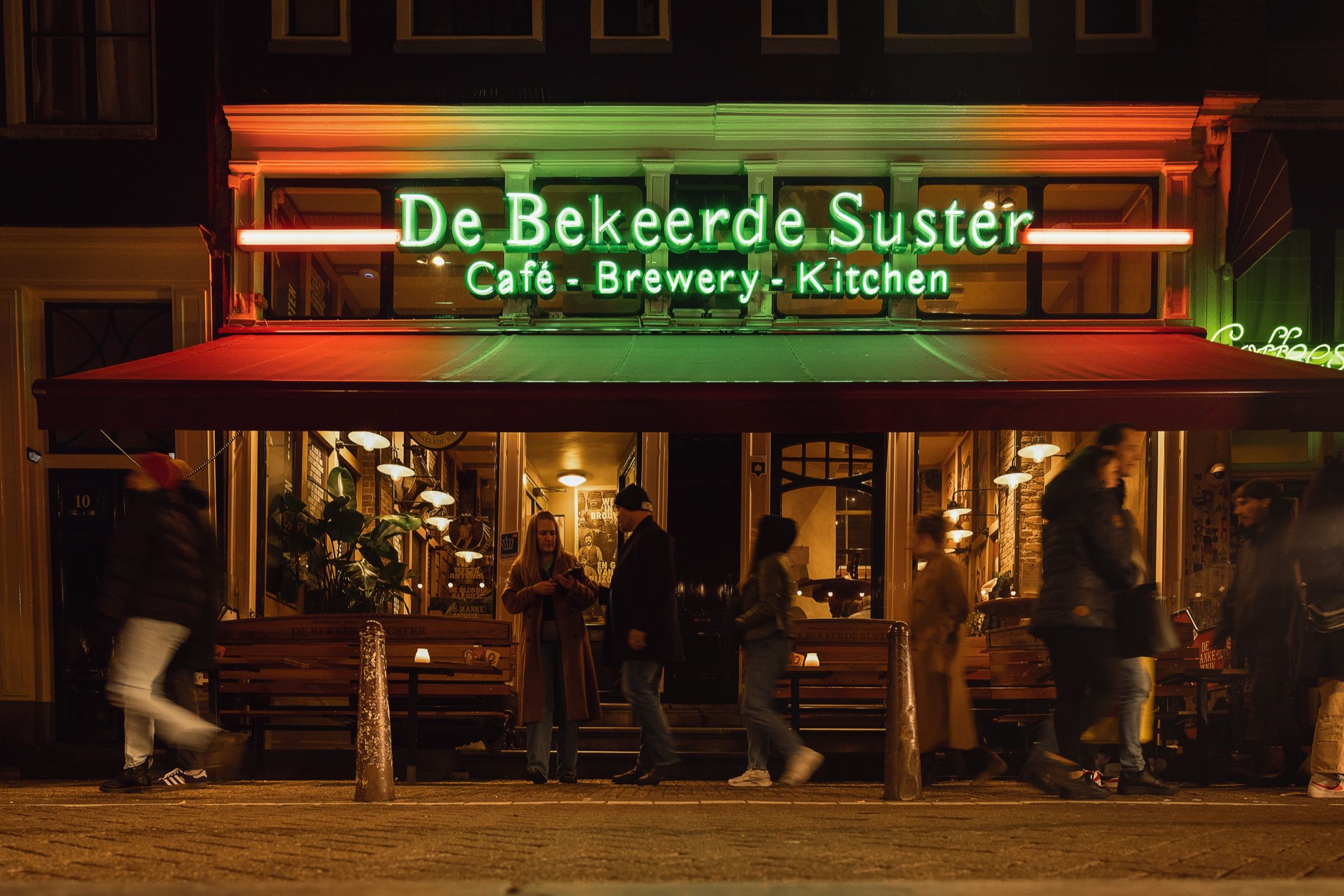
The facade at night with the neon sign reading Cafe, Brewery, Kitchen and guests standing outside.
Numbers 6 and 8 today.

Year: 1992

Brouwhuis Maximiliaan

In 1992 the brothers Albert and Casper Hoffman opened Brouwhuis Maximiliaan here, named after Emperor Maximilian, after three years of visiting brewpubs around the world. They had a brewhouse built to their own plans: hand-beaten copper, ten hectolitres a brew, standing beside the bar in full view. A Dutch firm took about eighteen months to make it.

Maximiliaan closed in 2002. The kettles stayed.

A brewer stirs the mash in the open copper kettle with a long paddle, below the portrait of the converted sister.
The copper of 1992, still at work.

Year: 2003–2004

De Bekeerde Suster

On 21 May 2003 the doors opened again under a new name, borrowed from the sisters who once lived here. The brewhouse was overhauled, and on 26 November 2004 the brewery officially started brewing as De Bekeerde Suster. The first brew was called Tom & Ton; Blonde Ros and Bock Ros followed as the first house beers. The three legends you drink today came later: Witte Antonia, De Blonde Barbier and De Manke Monnik.

A brewer stirs the mash in the open copper kettle with a long paddle, below the portrait of the converted sister.
At the kettle.

Year: 2022–now

A new chapter

In December 2022 Ramzy Group, an Amsterdam hospitality company, took over De Bekeerde Suster, and in 2023 the doors opened again. The brewing went on: the same copper, the three house beers, a seasonal from the same kettles. The neon on the facade is green, and you can see it from the Nieuwmarkt.

The facade at night with the neon sign reading Cafe, Brewery, Kitchen and guests standing outside.
The neon on the Kloveniersburgwal.

Year: Three legends

Tales from the tap

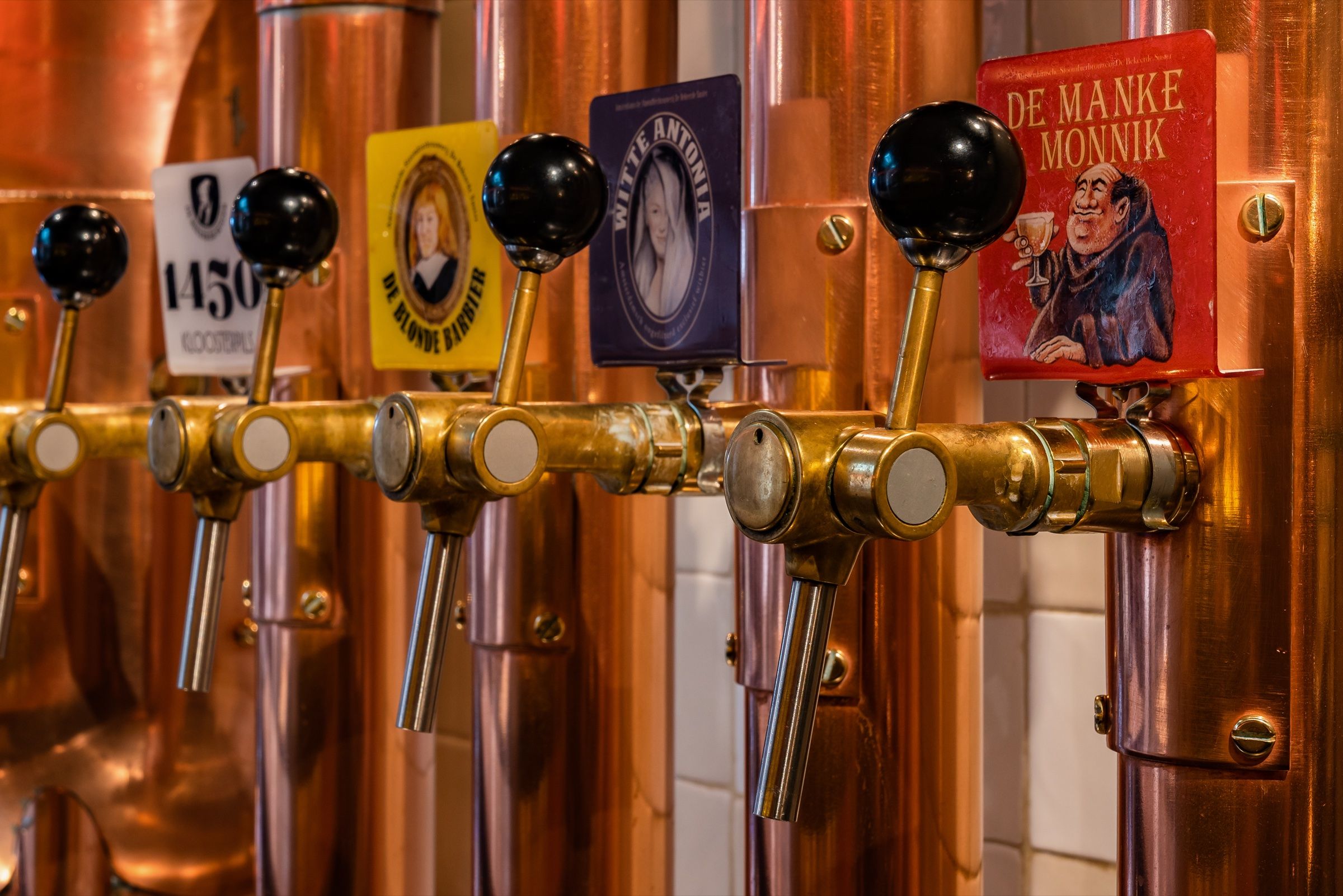
Our house beers carry the names of three figures. Witte Antonia, the story goes, was a sister of the convent, and her white habit named our witbier. De Blonde Barbier was a sixteenth-century barber-surgeon whose stories left you thirsty. De Manke Monnik limped through these streets, and nobody could say why.

None of the three has ever been found in an archive, and we do not pretend otherwise. The convent is history; the three are tales from the tap, and the beer is real.

Four copper beer taps on the bar, each with its own badge, including Witte Antonia, De Blonde Barbier and De Manke Monnik.
The three legends on tap.

Year: Walk it

Sixty seconds of history

You can walk the whole story in a minute. Start on the terrace and look up at the gable heads of Abraham and Isaac. The canal itself is named after the kloveniers, a division of the civic guard. Turn into the Barndesteeg: the long plastered wall halfway down is the convent's north wing, with the fifteenth-century cellar beneath it. Cross into the Koestraat, cut through the convent grounds in 1525 and named after the sisters' cows. The Bethaniënstraat still carries the convent's name. End on the Nieuwmarkt at the Waag, the old city gate, and walk back for a beer.

Then and now

Slide between the convent as it was drawn and the corner as it stands today. An old street photograph of the Kloveniersburgwal from the city archive will join the drawing here.

Drawing of the Bethaniën convent that once stood on this spot
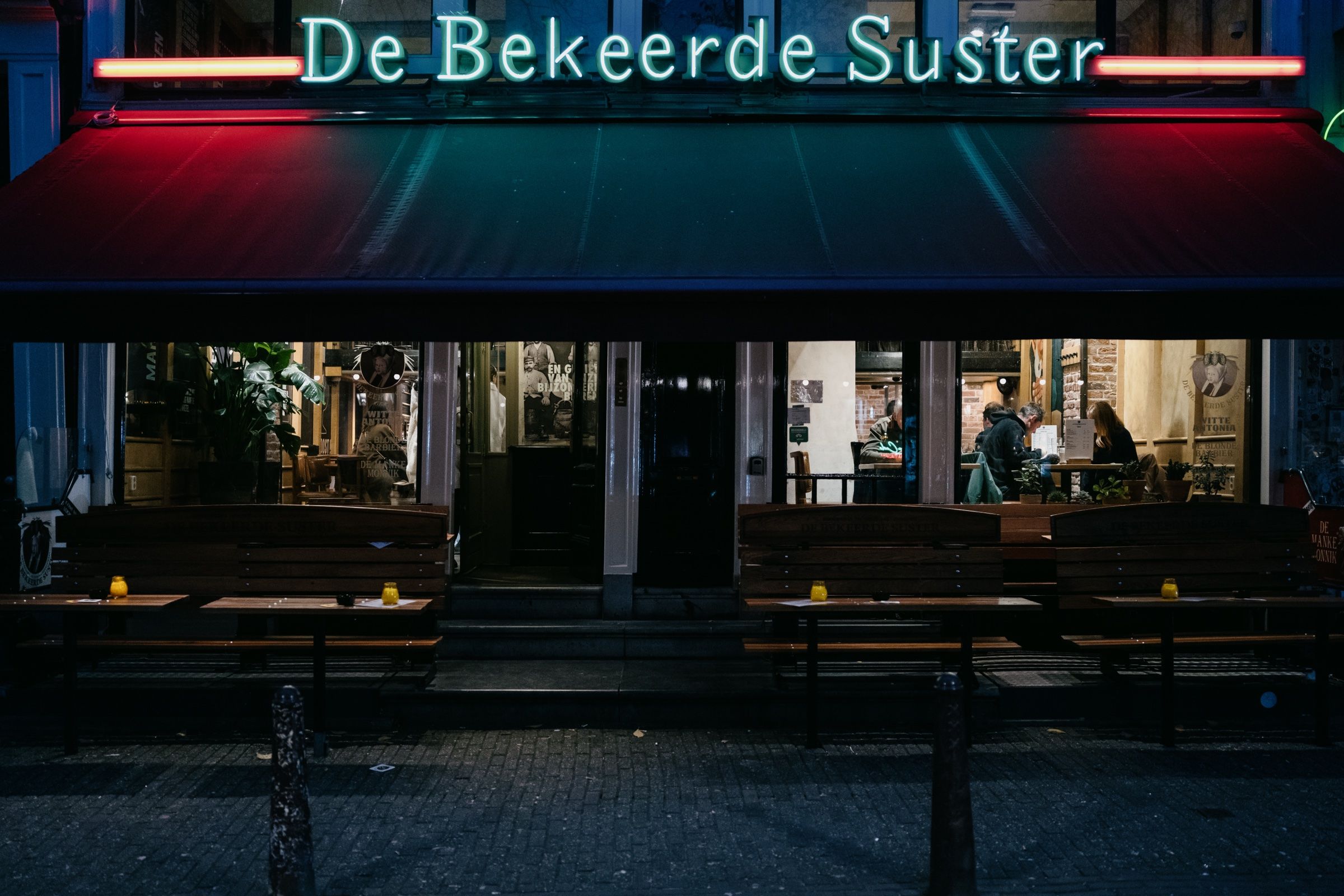
The front of De Bekeerde Suster at night, with the green neon sign above the red awning and empty terrace benches.
Then The convent, drawnNow The facade today

The banquet, up close

Bartholomeus van der Helst painted the Amsterdam civic guard at table on 18 June 1648, celebrating the Peace of Münster. The convent was gone by then, but this is the kind of feast its cattle once fed. Tap the marks.

Banquet of the Amsterdam civic guard celebrating the Peace of Münster, painting by Bartholomeus van der Helst, 1648
The captain
Captain Cornelis Witsen holds the guild's silver drinking horn. Lieutenant Johan van Waveren shakes his hand: the peace, sealed.
The beer
Glasses on the table: the guard drank beer and wine at its banquets, as the whole city did. Our kettles came three and a half centuries later.
The roast
The banquets of the civic guard ran on beef. A century before this one, the sisters of the Bethaniën convent fattened the cattle for them.
The toast
Glasses raised to the Peace of Münster, signed that year: eighty years of war with Spain were over.
The drum
The drum carries a poem by Jan Vos in praise of the peace. The painting was made for the hall of the crossbowmen's guild.
Bartholomeus van der Helst, Banquet at the Crossbowmen's Guild in Celebration of the Treaty of Münster, 1648. Rijksmuseum, public domain.

Enough reading

Taste the story

Up to 10 guests reserve online; 11 or more plan an event. Or walk in and start with a tasting flight of the three legends, from €12,90.